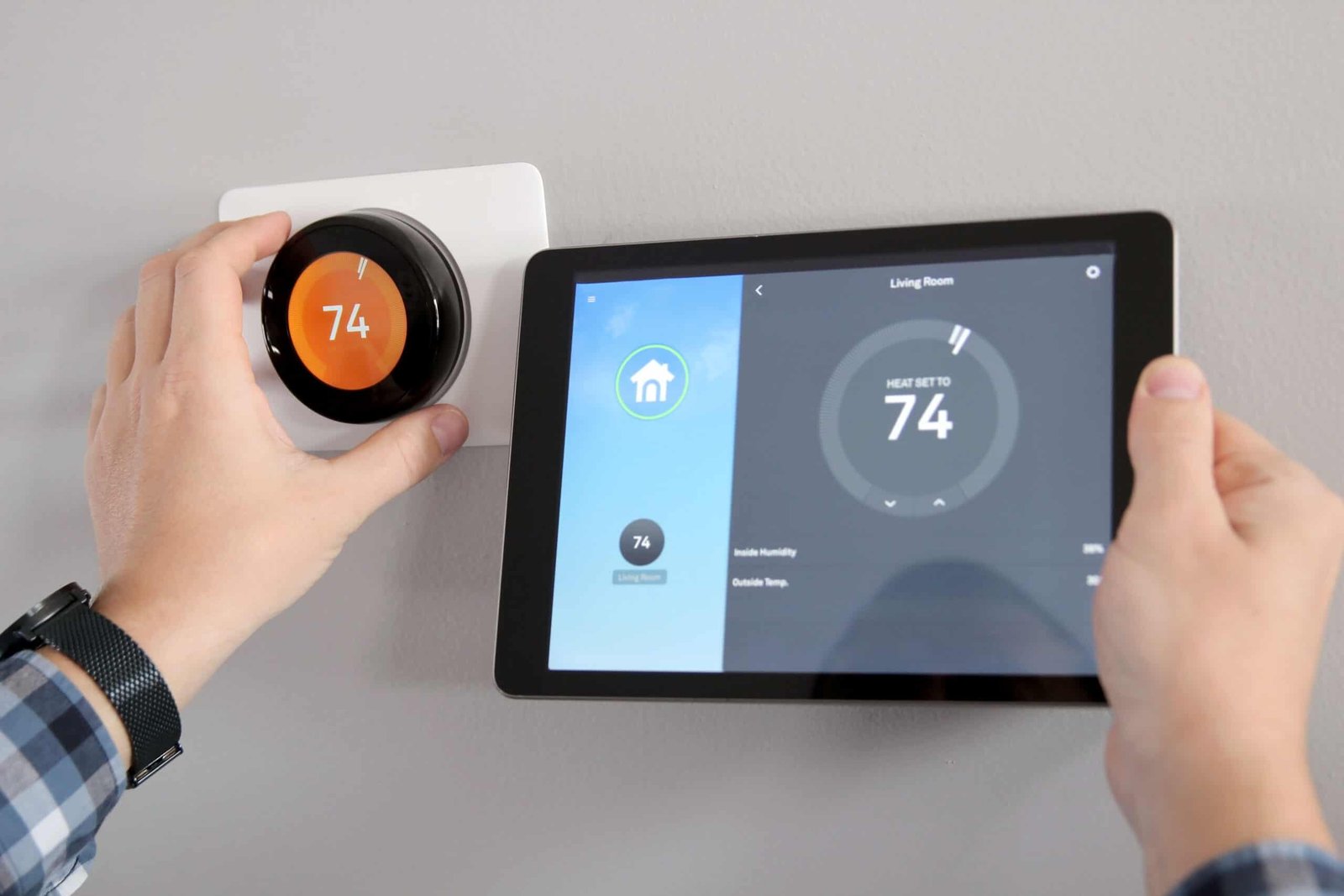
You need a smart thermostat if you want automatic savings and remote control without thinking about it, and a programmable thermostat is enough if you keep a steady routine and do not mind setting a schedule by hand. Both lower your bills the same way: by easing off the heating and cooling when you are asleep or away. The real difference is how much the device does for you, and whether you will actually use it.
That last part is the catch. A programmable thermostat only saves money if you program it and leave it alone. A smart thermostat saves whether or not you remember to. This guide walks through how each one works, what it costs you in effort, and which fits a River Valley home best.
What Is the Difference Between a Programmable and Smart Thermostat?
A programmable thermostat lets you set a heating and cooling schedule by hand. You tell it to ease off while you are at work and bring the temperature back before you get home, and it repeats that schedule on its own. It does not need Wi-Fi, an app, or a smartphone, and it cannot be changed from away.
A smart thermostat does all of that and connects to your home Wi-Fi. You control it from your phone, it can learn your habits and build its own schedule, and many models use geofencing to sense when you have left and set themselves back automatically. In short, a smart thermostat is a programmable thermostat with remote control and automation layered on top.
How Do Thermostats Actually Save Money?
Both types save the same basic way, by shrinking the gap between your indoor and outdoor temperature when no one needs full comfort. According to the U.S. Department of Energy, you can save as much as 10 percent a year on heating and cooling by setting your thermostat back 7 to 10 degrees for 8 hours a day. In summer that means letting the house drift warmer while you are out.
A common worry is that the AC has to work overtime to recover, canceling the savings. That is a myth. The longer your home sits closer to the outdoor temperature, the slower heat creeps in, so you come out ahead even counting the recovery. The savings are real either way. The question is which thermostat reliably delivers them.
Is a Smart Thermostat Worth It?
A smart thermostat is worth it for most homes, because it removes the one thing that defeats a programmable: human habit. Studies have found that a large share of programmable thermostat owners override the schedule or never set one at all, which erases the savings the device was supposed to deliver. The smart model takes the forgetting out of the equation.
ENERGY STAR, using real field data, found that a certified smart thermostat saves roughly 8 percent on heating and cooling, and that homes in climates with big temperature swings, like ours, tend to see the most. Add remote control for when you are away, learning that builds your schedule for you, and alerts when something is off, and the higher upfront cost usually earns itself back.
When Is a Programmable Thermostat Enough?
A programmable thermostat is enough when your schedule is steady and predictable, and you are the type who sets it once and leaves it alone. If you leave and return at the same times most days, a good schedule captures nearly all the available savings without any Wi-Fi or app.
It is also the better pick in a few specific cases. If you do not want a device connected to the internet, a programmable model sidesteps that entirely. If your Wi-Fi is spotty, a smart thermostat loses its best features anyway. And if you prefer simple buttons over a smartphone, there is no reason to pay for automation you will not use. The honest rule: pick the one you will actually operate.
Will a Smart Thermostat Work With My HVAC System?
Most smart thermostats work with most central heating and cooling systems, but there is one wiring detail worth knowing before you buy. Many smart models need a C-wire, a common wire that supplies steady power. Newer homes usually have one. Some older Fort Smith and Van Buren homes do not, and that is a frequent surprise during a do-it-yourself install.
This is the part homeowners get wrong most often, and a miswired thermostat can leave you with no cooling on a 95-degree afternoon. The fix is simple for a pro: we confirm the wiring, add a C-wire adapter if needed, and make sure the thermostat is placed away from sun and vents so it reads the real room temperature. Our smart thermostat services handle the whole job so the features actually work.
Does a Smart Thermostat Work Without Wi-Fi?
A smart thermostat still heats and cools without Wi-Fi, but it loses the features you paid for. Any schedule you already set keeps running, so your home stays comfortable. What you lose while the connection is down is remote control from your phone, geofencing, and the learning that builds your schedule automatically. It will not reset or shut off on its own.
That matters for the buying decision. If your Wi-Fi drops often or the signal is weak where the thermostat sits, a smart model spends a lot of time acting like a basic programmable one. In that case, either fix the signal with a range extender first, or save the money and choose a programmable thermostat outright.
How Do I Choose Between Them?
Choosing comes down to a few honest questions about your home and your habits. Run through these before you buy, and the answer usually picks itself.
- Pick a smart thermostat if you have an irregular schedule, want to control the temperature from your phone, or know you will not keep a manual schedule updated.
- Pick a programmable thermostat if your routine is steady, you want a lower upfront cost, or you would rather not depend on Wi-Fi.
- Either way, set summer to around 78 degrees when home and higher when away to capture the savings.
- Either way, place the thermostat on an interior wall, away from sun, drafts, and supply vents.
If you are still unsure, the simplest path is to have a technician look at your system and your wiring and match you to the right device, instead of guessing in a hardware-store aisle.
Talk to a Fort Smith Pro Before You Buy
The best thermostat is the one that fits your HVAC system, your wiring, and the way you actually live. A quick professional look saves you from buying a smart model your home cannot fully power, or settling for a programmable one when automation would serve you better.
Our veteran-owned team serves Fort Smith, Van Buren, and Greenwood, and we help you choose, then install it right so the savings show up on your bill. Thinking about an upgrade? Contact Riverside Heating Air Plumbing to schedule your service today.